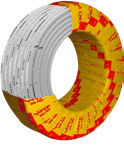
Multilayer pipe performs best when the complete system—pipe, fittings, tools and installation method—matches the project. A brand name or nominal diameter alone is not enough: temperature, pressure, flow, route length, pressure loss and service access must be considered together.
What is multilayer pipe?
A multilayer pipe combines polymer layers, a middle metal layer and bonding layers. In Newpipe PEX-b/AL/PEX-b products, cross-linked polyethylene sits on both sides of an aluminium layer. The metal layer supports dimensional stability and limits oxygen transmission, while the polymer layers form the fluid-contact surface and external protection.
ISO 21003 covers multilayer piping systems for hot- and cold-water installations inside buildings and for heating systems under design pressure and temperature classes. This does not mean every product suits every condition; the application class and limits in the selected product documentation remain decisive.
Common applications
- Domestic cold- and hot-water distribution
- Manifold layouts that reduce concealed joints
- Heating and underfloor-heating circuits where the application class permits
- Risers and distribution lines after sizing and pressure-loss calculations
How is pipe size selected?
Sizes such as 16, 20, 25 and 32 mm are catalogue options, not automatic answers. The calculation must consider fixture demand, simultaneous use, route length, elevation, inlet pressure, valves and bends, acceptable velocity and pressure loss.
| Factor | Effect | Common mistake |
|---|---|---|
| Route length | Longer routes create more pressure loss | Sizing only from fixture connection diameter |
| Simultaneous demand | Determines design flow | Simply adding every maximum fixture flow |
| Inlet pressure | Affects residual pressure at the farthest point | Ignoring pumps, tanks and floor height |
| Fittings | Each fitting adds local resistance | Calculating straight pipe length only |
Sample products for specification review
These links show sizes, supply form and listed prices for products carried by the store. Final selection must follow the project calculation.
Press or compression fittings?
The fitting must match the pipe structure and diameter, tooling and system instructions. Press joints require correct cutting, calibration and chamfering, full insertion, the specified jaw profile and a complete press cycle. Compression joints depend on square cutting, correct preparation, component positioning and tightening to the system instructions.
Press fittings can offer fast, repeatable installation, but the result depends on the condition and compatibility of the tool and jaw. Compression fittings may allow disassembly in some situations, but poor preparation or excessive tightening can cause problems. Choose according to access, service needs, installer competence and the approved system.
View a Newpipe press fitting in the store
Installation checklist
- Cut the pipe square with a suitable cutter.
- Calibrate and prepare the end exactly as instructed by the system supplier.
- Keep the pipe, fitting and seals clean and undamaged.
- Observe the permitted bend radius and avoid flattening the cross-section.
- Do not mix brands or systems without explicit manufacturer confirmation.
- Provide suitable support spacing, expansion allowance, insulation and protection at penetrations.
- Pressure-test the system before concealing the route.
- Photograph the installed joints and retain an as-built drawing.
Five costly mistakes
- Guessing the size from a previous project
- Using an incompatible or poorly maintained press jaw
- Concealing a joint where inspection is difficult
- Bending too tightly and deforming the pipe
- Covering the installation before pressure testing and documentation
Frequently asked questions
Which pipe size is suitable for a home?
Sizing depends on fixture demand, route length, inlet pressure, permissible pressure loss and simultaneous use. There is no single correct size for every home; use a drawing or calculation by a qualified installer.
Can multilayer pipe carry hot water?
Multilayer systems are designed for hot- and cold-water applications, but the application class, allowable pressure and temperature must be checked in the documentation for the selected system.
Are press fittings better than compression fittings?
Either can perform correctly when it belongs to a compatible system and is installed properly. Press fittings need the specified jaw profile and tool; compression fittings depend on correct pipe preparation and tightening.
Can pipes and fittings from different brands be mixed?
Do not mix them unless the manufacturer explicitly confirms compatibility. Tolerances, press profiles and joint construction can affect sealing and the system warranty.
Sources and methodology
This guide supports preliminary selection; it does not replace a services calculation, installation drawing or manufacturer instructions. Confirm current price and availability when ordering.
- ISO/TS 21003-7:2019 — Multilayer piping systems
- ISO catalogue — ISO 21003-2, multilayer pipes
- ISO catalogue — ISO 21003-3, fittings