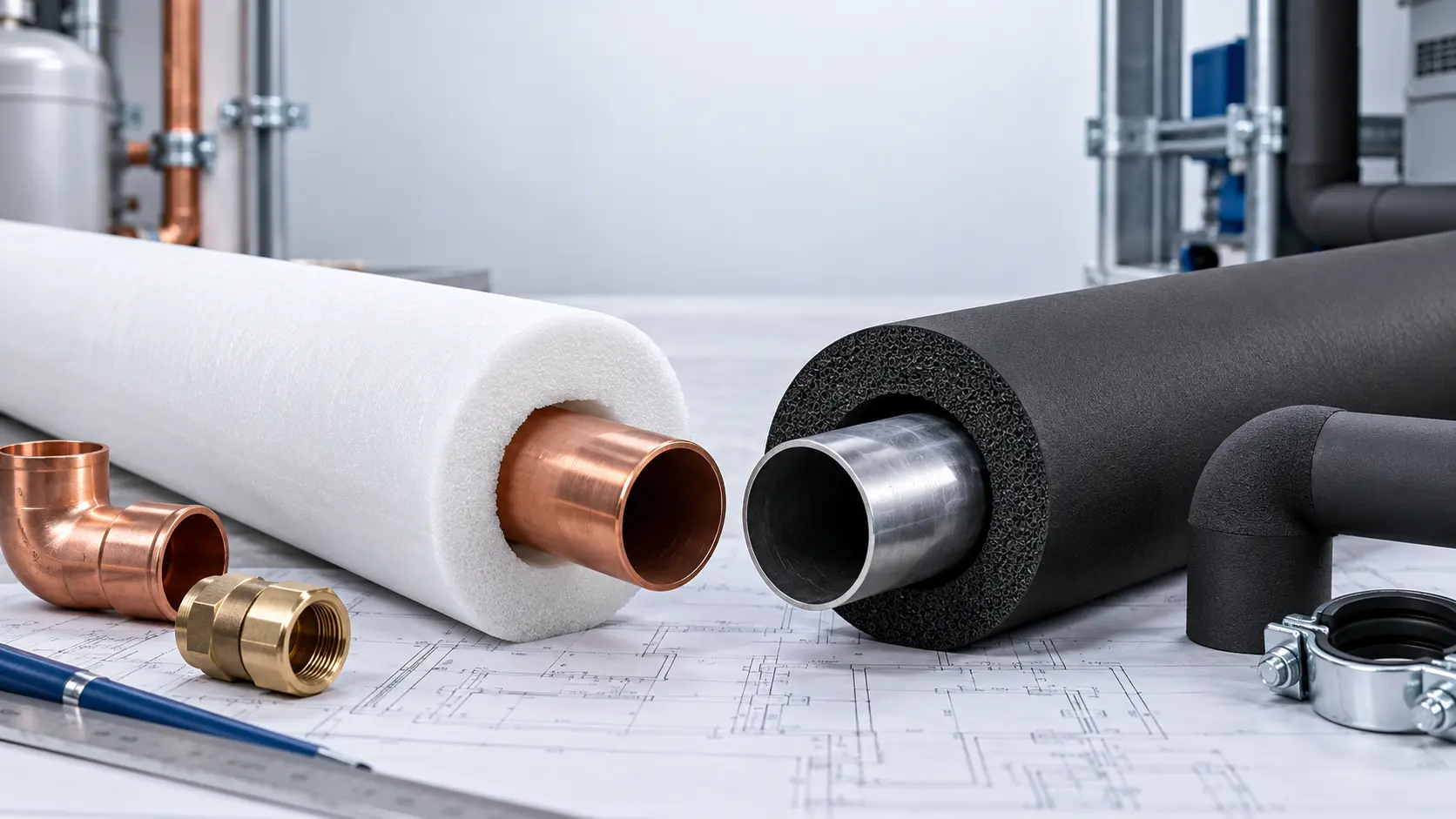
White polyethylene tube insulation and flexible elastomeric insulation both limit heat transfer, but they differ in composition, moisture resistance, durability, installation and cost. The right choice depends on fluid temperature, ambient humidity, location and joint quality—not colour or purchase price alone.
First: white is a colour, not a material
In Iran, “white pipe insulation” usually means closed-cell polyethylene foam. Colour alone does not prove composition, however, and elastomeric products can also have light-coloured finishes. Check the material, service-temperature range, water-vapour performance and installation instructions in the product data sheet.
What is white polyethylene insulation?
It is normally a lightweight, closed-cell polyethylene foam tube supplied in several diameters and wall thicknesses. Low weight, simple cutting and relatively low initial cost make it common for indoor building pipework.
- Strengths: economical, light and easy to install.
- Limitations: durability depends on product quality and workmanship; outdoor use requires UV and mechanical protection.
- Typical use: indoor domestic hot- and cold-water lines within the manufacturer's service limits.
What is elastomeric insulation?
Flexible elastomeric insulation is commonly made from engineered rubber foams such as NBR/PVC or EPDM. Its closed-cell structure and resistance to water-vapour ingress make it suitable for condensation control on cold services. Longitudinal seams, butt joints, elbows and support penetrations must be sealed using compatible system materials.
- Strengths: flexible, durable and well suited to vapour control when correctly installed.
- Limitations: higher initial cost and greater dependence on accurate cutting and adhesive work; outdoor service normally needs UV protection.
- Typical use: chilled water, refrigeration, HVAC plant rooms and humid locations.
Side-by-side comparison
Swipe left or right to view all columns.
| Criterion | White polyethylene | Elastomeric |
|---|---|---|
| Typical structure | Closed-cell PE foam | Flexible closed-cell rubber foam |
| Initial cost | Usually lower | Usually higher |
| Condensation control | Suitable for lighter duties when continuous | Usually better suited to cold, humid duties |
| Installation | Simple and quick | Requires careful cutting, bonding and sealing |
| Complex details | Good for simple runs | More flexible around fittings |
| Outdoor exposure | Both require suitable UV, weather and impact protection | |
| Typical application | Domestic hot and cold water | Chilled water, refrigeration and HVAC |
Closed-cell construction does not remove the need for sealing. Open seams or damaged surfaces can allow water vapour to reach a cold pipe and create concealed condensation.
Which should you choose?
Indoor hot-water pipework
When the service temperature is within the product rating and exposure is moderate, white PE insulation can be a practical economy choice. In plant rooms or trafficked locations, assess jacket durability and joint quality carefully.
Cold-water and chilled lines
Here, condensation prevention is as important as thermal performance. In humid areas or on low-temperature pipework, correctly sized and continuously sealed elastomeric insulation often provides a stronger solution. Inadequate thickness or open joints can defeat even a high-quality material.
Outdoor and rooftop routes
Do not leave either product unprotected. Sunlight, rain, birds and impact can damage insulation; the protective finish must suit the insulation system and local climate.
Benefits of correct pipe insulation
- Reduces heat loss from hot pipes and heat gain into cold pipes
- Helps control surface condensation and dripping
- Improves fluid-temperature stability and limits unnecessary plant load
- Provides some surface and contact protection
- Creates a tidier installation and may reduce moisture-related repairs
For the fundamentals, read Pipe Insulation: Benefits, Types and Correct Installation.
Purchase and installation checklist
- Record the conditions: outside pipe diameter, fluid temperature, humidity, location and exposure.
- Read the data sheet: temperature limits, thermal conductivity, vapour performance, fire behaviour and installation method.
- Select thickness for the objective: cold services require a condensation assessment.
- Prepare the pipe: correct leaks, corrosion and moisture before covering it.
- Keep the system continuous: elbows, tees, valves and supports are common weak points.
- Protect exposed insulation: provide a suitable finish outdoors or where impact is likely.
Frequently asked questions
Is white pipe insulation always polyethylene?
It commonly is in the Iranian market, but colour is not conclusive. Verify the material and technical data.
Which is better for cold-water lines?
For humid and condensation-prone duties, correctly sized and fully sealed closed-cell elastomeric insulation is usually the safer choice.
Can white PE insulation be used on hot water?
Yes, for many building hot-water applications, provided the actual temperature is within the manufacturer's stated range.
Is thicker insulation always better?
No. Thickness should suit pipe size, temperatures, humidity and the project objective; continuity of installation is equally important.
Sources and preparation
This comparison draws on official technical information about closed-cell polyethylene and elastomeric insulation. Product properties vary, so always use the data sheet for the selected brand and model.
- Thermaflex — Closed-cell polyethylene pipe insulation
- Armacell — Flexible closed-cell elastomeric insulation
- Armacell — Why insulate plastic pipes?