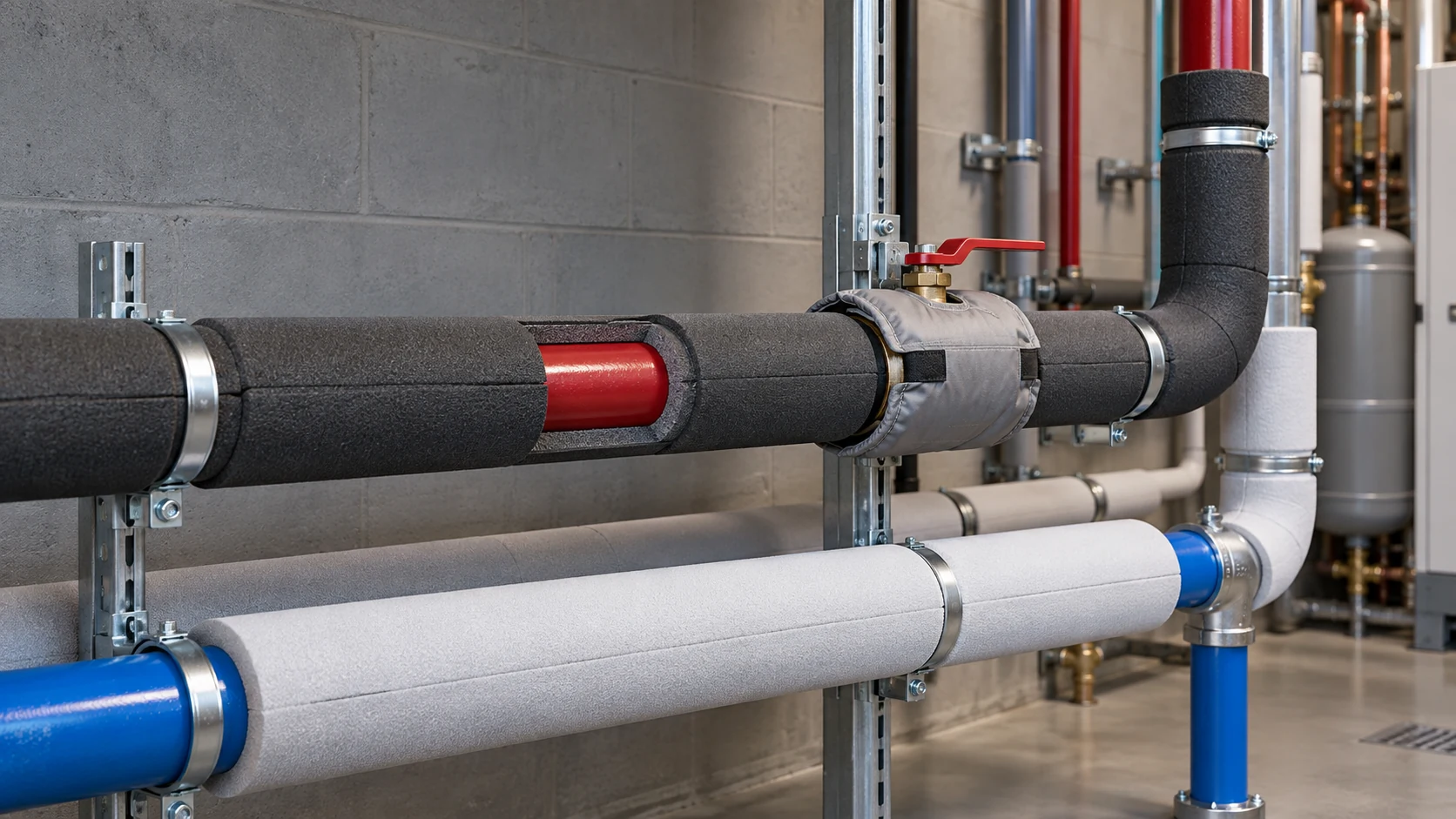
Water and other fluids travel through many kinds of spaces before reaching their destination: risers, ceiling voids, plant rooms, garages, roofs and exterior runs. Tubular pipe insulation slows heat exchange between the pipe and its surroundings. It helps hot water retain temperature, limits sweating on cold pipes and slows temperature drop along the route. The result depends on the material, thickness, continuity of installation and actual project conditions.
What does pipe insulation do?
Insulation creates a layer of low thermal conductivity around a pipe. On a hot-water line, it slows heat leaving the pipe; on a cold-water or chilled line, it limits heat entering from the surroundings. Performance depends on more than the material name: thickness, joint quality, moisture resistance and operating conditions matter too.
The U.S. Department of Energy’s Building Science Education program identifies reduced heat loss as a key reason to insulate hot-water piping. Building America studies cited by the program estimate distribution losses of 16% to 23% in uninsulated hot-water pipes, depending on climate; in those U.S. study conditions, adding ¾-inch (about 19 mm) pipe insulation was associated with a 4% to 5% reduction in annual water-heating energy use. These figures are not a guaranteed saving for an Iranian building: pipe length, water temperature, usage and installation details change the result.
Main benefits of pipe insulation
- Less heat loss from hot water: Heat escapes more slowly along the route, reducing the need for heating equipment to make up that loss.
- More stable water temperature: It limits temperature change along longer distribution and recirculation runs, risers and plant-room piping.
- Less condensation on cold pipes: With enough thickness and a continuous vapor-control layer, insulation can keep the outer surface above the surrounding air’s dew point and reduce dripping onto ceilings and walls.
- Slower cooling in cold weather: Insulation buys time by slowing heat loss, but it does not guarantee that water will not freeze in severe conditions.
- Protection around hot and sweating pipes: Insulation can reduce accidental contact with a hot pipe and help prevent moisture damage to nearby finishes; safety design and maintenance access are still necessary.
Which pipes are good candidates?
Common priorities include domestic hot-water and hot-water recirculation lines; heating supply and return pipes; cold or chilled pipes in humid spaces; and pipes routed through unheated garages, basements, roofs, ceiling voids or outdoors. The goal varies: hot-water insulation preserves temperature, cold-pipe insulation controls condensation and heat gain, and insulation on exposed runs slows cooling.
| Application | Main goal | Selection check |
|---|---|---|
| Domestic hot water | Limit heat loss and temperature drop | Product temperature rating and sealed joints |
| Cold or chilled water | Control condensation and heat gain | Closed-cell material or a continuous sealed vapor retarder |
| Higher-temperature heating | Reduce heat loss and hot-surface contact | Material rated for operating temperature, such as protected mineral or glass wool |
| Outdoor or cold-exposed runs | Slow cooling and protect the system | UV, moisture and impact protection; controlled heat tracing if designed |
Types of pipe insulation and material selection
Closed-cell foam sleeves
Flexible polyethylene or elastomeric tubular sleeves are used on many hot- and cold-water pipes within the product’s temperature range. A closed-cell structure can limit water absorption, but the longitudinal seam, end joints, elbows and tees still need to be properly closed. On cold lines, continuity of the vapor retarder is especially important.
Glass wool and mineral wool
These materials are used on some higher-temperature heating lines and larger pipes, usually with a protective jacket. Select them for the operating temperature, moisture exposure, fire requirements and manufacturer instructions. Wet or compressed fibrous insulation will not deliver its intended performance.
How is thickness selected?
There is no single thickness for every pipe. Fluid and ambient temperatures, pipe outside diameter, operating hours, humidity, air movement, installation location and the project’s energy or condensation-control target all affect the calculation. Use the manufacturer’s table for the actual conditions. For chilled or process lines, have the designer specify thickness and the vapor-retarder system; do not copy a value from another project.
Application in Iranian buildings
In Iranian buildings, risers and pipes passing through garages, basements, roofs and ceiling voids are worth checking for hot-water temperature loss. In humid northern and southern cities, cold-water and chilled lines are more prone to condensation; continuous vapor control, sealed elbows and protection from moisture are important. In colder regions, insulation only slows cooling: pipe location, airflow, draining when out of service and, where designed, controlled heat tracing need separate consideration.
Pipe insulation is different from insulation beneath underfloor-heating circuits: one wraps around an individual pipe, while the other is part of the floor build-up. For the latter, read our underfloor-heating insulation guide.
Installation checklist
- Measure the pipe: Match the sleeve’s inner diameter to the pipe’s outside diameter. Avoid sleeves that are loose, compressed or discontinuous.
- Start with a dry, sound pipe: Check for leaks, corrosion and existing moisture before covering the line.
- Close seams and fittings: Bring sleeve ends together without gaps and fully cover elbows, tees and supports.
- Keep the vapor retarder continuous on cold lines: A cut, hole or open joint can let moisture reach the pipe and cause hidden condensation.
- Protect outdoor jackets: Use a cover suited to UV, rain, impact and maintenance conditions.
- Preserve service access: Use removable jackets at valves and repair points instead of permanently hiding them.
Common mistakes
- Choosing by price or visible thickness alone
- Using ordinary foam on a line hotter than the product’s rated range
- Leaving gaps at seams, elbows and valves, or breaking the vapor retarder on a cold line
- Covering a wet or leaking pipe without fixing the cause
- Leaving outdoor insulation exposed to sun, rain or impact without a protective jacket
- Assuming insulation alone completely prevents freezing or energy loss
Frequently asked questions
Does pipe insulation make hot water arrive sooner?
No. It slows cooling in the pipe. Actual waiting time depends on the route length and diameter and the hot-water circulation design.
Does insulation prevent pipes from freezing?
It does not guarantee freeze prevention; it only slows temperature drop. Location, airflow, draining and any heating measure should be evaluated separately.
What insulation should be used on cold-water pipes?
Choose material and thickness for the water temperature and surrounding humidity. To control condensation, sleeve joints must be continuous and the vapor retarder must remain sealed.
Can the same insulation be used on hot and cold pipes?
Not always. Operating temperature, humidity, fire performance and installation conditions may require different materials or jackets. Check the product rating.
Sources and preparation
This article draws on U.S. Department of Energy and Pacific Northwest National Laboratory educational guidance on plumbing-pipe insulation, and the ASHRAE Handbook chapter on pipe-insulation systems. The cited energy-saving percentages come from U.S. studies and must be evaluated against each project’s conditions.
- U.S. Department of Energy, Building Science Education — Pipes in Exterior Walls
- Pacific Northwest National Laboratory — Insulate Hot Water Pipes
- Building America Solution Center — Insulating Plumbing Pipes
- ASHRAE Handbook — Insulation Systems for Refrigerant Piping